Online Course
NURS 834 - Translating Evidence to Practice
Module 5: Implementing Change and Design for Evaluation
Approaches to Economic Analysis
Define terms:
- Macroeconomics - The branch of economics that examines the workings and problems of the economy as a whole—GDP growth and unemployment.
- Microeconomics - The branch of economics that examines individual decision-making at firms and households and the way they interact in specific industries and markets.
There are multiple approaches to economic analysis. To introduce you to some of the concepts and common analytic approaches, review the following resources:
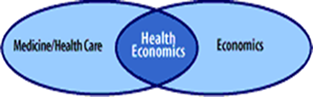
This link provides a brief overview of Health Economics:
https://www.youtube.com/watch?v=bUay9DV__G0
Why is it important to look at economics in health? There are several reasons. Health resources are finite. A choice must be made about which resources to use for which activities. By choosing to use resources for one activity, the opportunity of using those resources for alternative activities is given up and the benefits associated with the best alternative use of resources is lost. This is called the opportunity cost .
The aim of economics is to ensure that the chosen activities have benefits which outweigh their opportunity costs OR the most beneficial activities are chosen within the resources available.
Economics is concerned with efficiency but it is more than just efficiency.
Efficiency is not the only objective in choosing how health care resources should be allocated. We also need to think about equity, or the fair distribution of resources and benefits, which is also an objective in health care decision-making. Economics provides an information framework in which the objectives of both efficiency and equity may be pursued. Economics also provides a framework which aims at maximizing benefits within available resources.
Four-common approaches to economic analysis are:
- cost-minimization analysis – choosing the most inexpensive intervention by comparing the costs of achieving a selected outcome (e.g., selecting generic versus non-generic drugs for pain)
- cost-effectiveness analysis – comparing the costs per unit of outcome among alternative interventions that produce the same or similar effect (e.g., selecting an intervention which has more positive outcomes versus alternative interventions)
- cost-utility analysis – measuring an intervention’s effect on both quantitative and qualitative aspects of health (e.g., the effect on morbidity and mortality as well as quality of life and is often expressed as cost per quality-adjusted life years – QALY)
- cost-benefit analysis – assigning a monetary value to each outcome of preventive interventions to determine if the benefits exceed the cost and whether to implement a program
Economic evaluation - identification and measurement of benefits |
||
|---|---|---|
| Evaluative Technique | Benefits | Unit of Measurement |
| Cost-effectiveness analysis | Quantity of Life OR Quality of Life |
Cost per case of disease prevented or cost per death averted |
| Cost-utility analysis | Quantity AND Quality of Life |
Health Years; e.g., QALYs Combine the effects of a product on both length of life (how long people live for) and quality of life (how well people are) |
| Cost-benefit analysis | Quantity + Quality of life (may include some non-health aspects |
Cost in units of money/benefits in units of money. |
The Agency for Healthcare Research and Quality (AHRQ) in its toolkit for quality indicators has an appendix that describes a return on investment (ROI) tool to evaluate cost and returns for new quality interventions/programs.
This website is maintained by the University of Maryland School of Nursing (UMSON) Office of Learning Technologies. The UMSON logo and all other contents of this website are the sole property of UMSON and may not be used for any purpose without prior written consent. Links to other websites do not constitute or imply an endorsement of those sites, their content, or their products and services. Please send comments, corrections, and link improvements to nrsonline@umaryland.edu.