Online Course
Nurs 659 - Organizational/Professional Dimensions
Module 6: Performance Improvement
The performance improvement process
The Institute for Healthcare Improvement has estimated that 15 million incidents of patient harm occur in US hospitals each year. As a result, The 5 Million Lives Campaign was an initiative to protect patients from five million incidents of medical harm over two years (December 2006 – December 2008).
This program builds on and extends an earlier initiative to protect 100,000 lives.
Enter Performance Improvement
What is the foundation for the current performance improvement initiatives?
The performance improvement initiatives date back many years ago and continue to go through several revolutions. Walter Shewhart is credited as being the grandfather of total quality management and the precursor to much of the work in quality among all disciplines. (Reference from http://www.skymark.com/resources/leaders/shewart.asp)
The imperative for performance improvement is further reflected in the myriad of documents and initiatives to save lives. There is also recognition that in a cost-containment environment, scarce resources are issues: “Process Improvement: scarce resources make prioritizing a must; existing or potential problems, outside agencies key determinants”
Process Improvement Model
Although there are numerous process improvement models, the basic steps to the improvement process are found in the PDSA Cycle below.
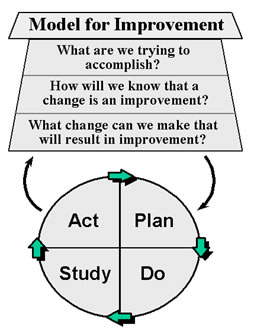 |
A Model for Improvement:
|
Developing/Identifying Indicators
Once the three questions are answered, the practitioner is ready to begin the improvement process using the PDSA Model. A critical next step is to clearly identify what quality indicators are appropriate, and which ones the APN will use for measurement of the practice.
Multidisciplinary quality indicators have been the standard for evaluating specific patient populations. However, the practice of nursing is not reflected in these multidisciplinary indicators. Hence, the need for nurse-sensitive indicators to reflect the unique contributions of nursing. There is a need for a combined approach and thus, the leadership role of the APN is imperative.
Sources to guide the practitioner include (1) The National Database of Nursing Quality Indicators (NDNQI) (2) The Hamric et. al. (2014) Model of Advanced Nursing Practice-specific structure, process and outcome variables (3) National Quality Forum
Using the PDSA Model
The PDSA Model is articulated in a six step process:
The application of the PDSA model may be seen in a sample completed improvement projects at http://www.luhs.org/depts/cce/tools/ex_rept.htm |
Performance Improvement Process Tools
One of the most rewarding, yet challenging, aspects of performance improvement is the appropriate use of the many tools and processes available. The process is made richer by the application of tools in the data collection, analysis, study, and presentation. The choice and appropriateness of tools to use depend on the stage of the process in which data collection, analysis, studyor presentation is appropriate.
Tools and processes are often organized into sample categories such as:
- gathering processes (check sheets, sampling, surveys, multivoting, nominal group technique)
- analyzing information (cause/effect diagrams, pareto diagrams; flow charts, etc.)
- working in groups (affinity grouping, multivoting, nominal group technique)
- documenting the work
There are extensive performance improvement tools available. While it is not possible to master all the tools, at the completion of this module, you should be comfortable with a working knowledge of the following tools found at http://www.skymark.com/resources/tools/management_tools.asp
|
Review and practice a variety of tools using sample data that you create. This opportunity will prepare you in conducting performance improvement projects in your practice setting.
This website is maintained by the University of Maryland School of Nursing (UMSON) Office of Learning Technologies. The UMSON logo and all other contents of this website are the sole property of UMSON and may not be used for any purpose without prior written consent. Links to other websites do not constitute or imply an endorsement of those sites, their content, or their products and services. Please send comments, corrections, and link improvements to online@son.umaryland.edu.