Online Course
Nurs 659 - Organizational/Professional Dimensions
Module 6: Performance Improvement
Overview
| IOM Definition of Quality The degree to which health services for individuals and populations increase the likelihood of desired health outcomes and consistent with current professional knowledge. |
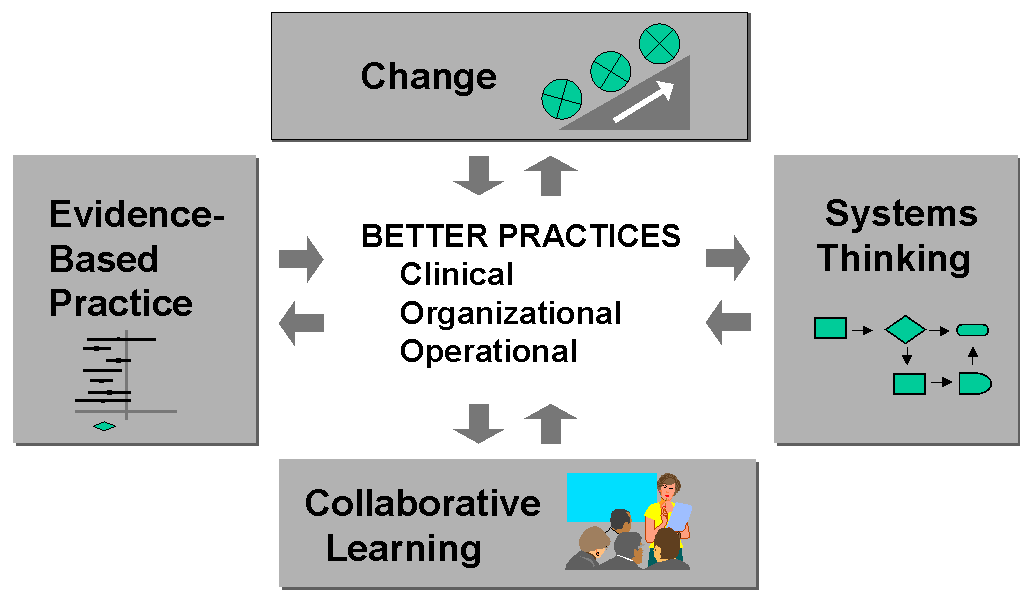
Performance (process) Improvement – (frequently used interchangeably with several of the above terms), is concerned with quality of services, and the degree to which these services maximize the potential for desired health outcomes. The focus of attention is on the measurement and monitoring of processes (interventions) related to the care provider and the organization to reach favorable outcomes. The performance improvement process also measures and monitors the structures and outcomes to determine the results of actions taken, and whether the process (interventions) produced the desired effect (Hamric et. al. 2014).
The traditional framework for improvement comprises quality measures or indicators that reflect to what extent individuals/organizational (1) structures (2) processes, and (3) outcomes assure quality of care. The Institute for Healthcare Improvement specifies two of the system concepts, while adding a third type measure: (1) process measures - the voice of the working system; (2) outcome measures - the voice of the customer or patient; and (3) balancing measures - those that examine the system from a different direction/dimension.
Review the Institute for Health Care Improvement website and check out the Improvement Map and the Partnership for Patients.
Although The American Nurses Association has identified nurse-sensitive outcome indicators to help demonstrate nursing’s unique contributions to healthcare (Duffy & Korniewicz, 2002), organizational effectiveness, reimbursement decisions, and evidence based practice decisions require the development of APN-sensitive data driven, outcome measures. Recognition of the need to examine ANP-specific practice, Hamric et. al. (2014) propose a dynamic quality health outcomes model that identifies specific structure, process and outcome variables valuable to the APN practice. The authors note that, “the more complete the model (e.g., inclusion of all or at least two of the components), the more likely is the successful isolation of the APN’s unique impact on care delivery outcomes."(p.612).
Advance practice nurses are also concerned with demonstrating leadership in performance improvement initiatives at the individual, unit and organizational levels. A key and continuing opportunity for the advanced practice nurse lies in the identification and development of APN-sensitive indicators and standards that will articulate the practice contributions at each level. Prior research skills, combined with the continuing education of performance improvement and outcomes evaluation, position the ANP to lead and improve individual and organizational ANP specific outcomes.
As leaders, it is further a requirement that APNs begin to think and demonstrate systems thinking, and leadership to build learning organizations (Please visit http://www.infed.org/thinkers/senge.htm and review the document). Performance improvement is inconsistent with individual thinking and planning. As nurses possess skill-specific behaviors that influence patient/client outcomes, the performance of these skills is not in isolation to other systems within the organization. Therefore a cornerstone of performance improvement is the ability to work within (intra) and across (inter) disciplines for patient/client-specific and organizational outcomes. Mastery of performance improvement skills at the individual/unit level allow for growth and advancement to leadership skills in developing and leading empowered and learning organizations. APN leaders facilitate the articulation of performance improvement measures at local, state and national levels.
This module, and the module that follows, explores the APN role in quality, safety, performance improvement and outcomes evaluation. Part I (this module) introduces the participant to the basic skills of performance improvement tools and processes.
Inseparable with performance improvement activities is outcomes evaluation which focuses on the impact of care delivery processes and areas in which additional improvements are needed. Integrated in this discussion are also the key issues of patient safety and evidence based practice. Subsequently, the module that follows will address specific leadership competencies and resources appropriate to developing strategies to facilitate program design and outcome evaluation for the APN.
This module begins the performance improvement process and offers additional resources for continued learning. Examine, explore and practice the skills to enhance leadership capabilities.
Objectives
At the conclusion of this module, the learner will be able to:
- Define performance improvement
- Identify components of the performance improvement process
- Describe the PDSA cycle and its application
- Describe nurse-specific, and ANP-specific structure, process and outcome variables
- Differentiate performance improvement tools as to purposes, appropriate uses and intended outcomes
- Utilize the performance improvement process to improve a potential ANP problem
Required Readings
- Hamric, A. B., Spross, J.A., & Hanson, C.M. (2014). Advanced Practice Nursing: An Integrative Approach. Elsevier Saunders: St. Louis Missouri. Chapters 23 & 24
- Newhouse, R.P., Pettit, J.C., Rocco, L., & Poe, S. (2006). The Slippery slope: Differentiating between quality improvement and research. JONA, 36(4), 211-219.
Directions
Read the module and suggested readings within the module. Then complete the assignment for the module.
This website is maintained by the University of Maryland School of Nursing (UMSON) Office of Learning Technologies. The UMSON logo and all other contents of this website are the sole property of UMSON and may not be used for any purpose without prior written consent. Links to other websites do not constitute or imply an endorsement of those sites, their content, or their products and services. Please send comments, corrections, and link improvements to online@son.umaryland.edu.