Online Undergraduate Course
Nurs 467 - Public Health Nursing
Module 11: Environmental Health and Emergency Preparedness
Disaster/Emergency Preparedness and Management
Disasters may seriously disrupt the functioning of a community or society causing widespread human, material, economic, or environmental losses that exceed the ability of the affected community to cope using its own resources. A disaster is a function of the risk process. It results from the combination of hazards, conditions of vulnerability, and insufficient capacity to reduce the potential negative consequences of the risk (UN/International Strategy for Disaster Reduction, 2022).
Disaster management is the organization and management of resources and responsibilities for dealing with all humanitarian aspects of emergencies, in particular preparedness, response, and recovery, to lessen the impact of disasters (International Federation of Red Cross and Red Crescent Societies Disaster Management). The primary objective of disaster management is to reduce morbidity and mortality from the disaster. Its fundamental principles are to prevent disaster, minimize casualties, prevent further casualties, rescue victims, provide first aid, evacuate the injured, provide medical care, and promote the reconstruction of lives.
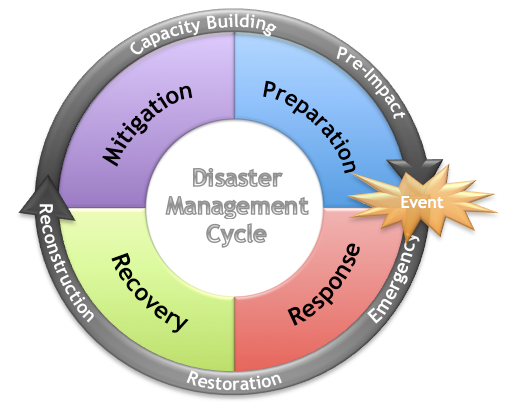
In the United States, disaster response starts at the local level. Local officials assess the potential or actual damage and ask for assistance from the state and federal governments, if needed.
Federal Level
The agencies responsible for disaster management at the federal level are the: 1) Centers for Disease Control (CDC), the National Disaster Medical System (NDMS), the Department of Homeland Security, and the Federal Emergency Management Agency (FEMA).
Centers for Disease Control (CDC) – CDC's Office of Public Health Preparedness and Response leads the agency's preparedness and response activities by providing strategic direction, support, and coordination for activities across CDC as well as with local, state, tribal, territorial, national, and international public health partners. CDC prepares local and state public health departments by providing funding and technical assistance to strengthen their abilities to respond to all types of emergencies and build more resilient communities.
When local and state resources become overwhelmed, CDC responds and supports national, state, and local partners to save lives and reduce suffering. This includes providing scientific and logistic expertise and deploying personnel and critical medical assets to the site of an emergency. CDC also helps these partners recover and restore public health functions after the initial response (Source: CDC). To learn more, please visit CDC's emergency preparedness and response page.
The National Disaster Medical System (NDMS) – The NDMS’s three main objectives are to provide medical assistance teams, evacuate patients to predetermined locations, and to provide a national network of hospitals to accept patients during a national emergency (Source: DHHS).
The NDMS supports federal agencies in the management and coordination of the federal medical response to major emergencies and federally declared disasters including:
- Natural Disasters
- Major Transportation Accidents
- Technological Disasters
- Acts of Terrorism including Weapons of Mass Destruction Events
- Caring for casualties evacuated to U.S. from overseas armed conflicts
Watch a short video about NDMS and the responders who work for this agency.
Watch NDMS Helps Protect Patients at MD Long-Term Care Facilities from COVID
Department of Homeland Security (DHS) – created in response to 9-11, the DHS’s primary mission is to keep the nation secure and safe from terrorist threats. One of DHS’s many duties is to provide a coordinated, comprehensive federal response in the event of a terrorist attack, natural disaster or other large-scale emergency while working with federal, state, local, and private sector partners to ensure a swift and effective recovery effort (Source: DHS).
Federal Emergency Management Agency (FEMA) – FEMA’s mission is to support our citizens and first responders to ensure that as a nation we work together to build, sustain, and improve our capability to prepare for, protect against, respond to, recover from, and mitigate all hazards. FEMA has developed and utilizes the National Response Framework (NRF), which provides the principles that enable all response partners to prepare for and provide a unified national response to disasters and emergencies, from the smallest incident to the largest catastrophe (Source: FEMA).
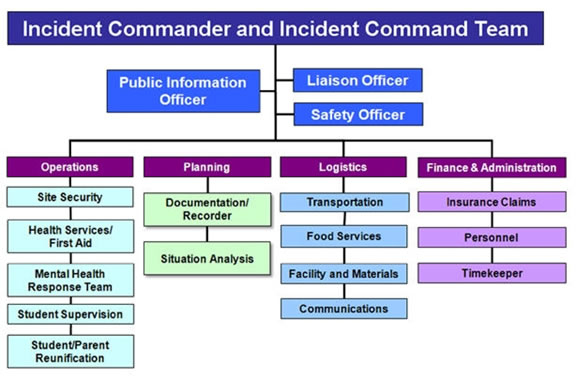
One of the framework’s key principles is the Incident Command System (ICS). This is a management system designed to enable effective and efficient domestic incident management by integrating a combination of facilities, equipment, personnel, procedures, and communications operating within a common organizational structure. A basic premise of ICS is that it is widely applicable. It is used to organize both near-term and long-term field-level operations for a broad spectrum of emergencies, from small to complex incidents, both natural and manmade. ICS is used by all levels of government—Federal, State, local, and tribal—as well as by many private-sector and nongovernmental organizations. ICS is also applicable across disciplines (Source: FEMA).
State Level
Disaster management at the state level is the responsibility of state governments. States have an Emergency Operations Plan (EOP), which often mirrors the National Response Framework. The EOP assigns duties and responsibilities to agency heads or organizations that support local governments during emergencies. As a first priority, the state’s governor will open an Emergency Operations Center (EOC), where these agencies and organizations work together to coordinate disaster relief efforts. When a governor opens an EOC, this triggers FEMA involvement. The Maryland Emergency Management Agency (MEMA) is the disaster management agency for Maryland.
Local Level
At the local level, emergency response and disaster management may include governmental agencies at the county, state, and federal levels and the American Red Cross. When the emergency or disaster is locally focused, the local official must ask for assistance from the state if needed. For example, during the riots in Baltimore after Freddie Gray’s death, Governor Hogan could not just send in the National Guard, he had to wait for Mayor Rawlings-Blake to make the request. Local hospitals are an important resource in all phases of an emergency and often have their own Emergency Operations Plans. Many hospitals hold mock disaster drills (scheduling these drills is a part of the plan itself) to make sure everything runs as smoothly as possible should an actual disaster occur.
The chemical spill at the Solvay plant involved a private company, which complicated matters. Although company employees handled some of the immediate response, the Baltimore City Fire Department quickly took over. When an emergency involves a private company, coordination between private industry and local/state/federal responders is critical to protect public health.
Volunteer Agencies
American Red Cross (ARC) – The American Red Cross is the primary voluntary national disaster relief agency. ARC is ready for immediate action in every part of U.S. and provides damage assessment after a disaster occurs, mass care to those and affected by the disaster, health care services, family services, and disaster welfare inquiry services, which collects information about individuals within affected areas to aid in reunification of families separated at the time of the disaster or provide family members outside the disaster area with information about their loved ones.
Medical Reserve Corps (MRC) – The MRC’s mission is to establish teams of local volunteer medical and public health professionals who can contribute their skills and expertise throughout the year as well as during times of community need. Volunteers supplement existing emergency and public health resources and are medical and public health professionals, such as physicians, nurses, pharmacists, dentists, morticians, veterinarians, and epidemiologists. There are 989 MRC Units across the U.S. with 9 units in Maryland.
Communities have a number of first responders, such as firefighters, police officers, and EMT/paramedics, and governmental and volunteer agencies to assist them when a disaster strikes. However, these dedicated responders and agencies need help from community members so that response and recovery efforts are maximized. Community organizations like Citizen Corps help communities plan for emergencies and provide support and volunteer opportunities for community members to get involved. (Source: Ready.gov).
Other Disaster Management Resources
This website is maintained by the University of Maryland School of Nursing (UMSON) Office of Learning Technologies. The UMSON logo and all other contents of this website are the sole property of UMSON and may not be used for any purpose without prior written consent. Links to other websites do not constitute or imply an endorsement of those sites, their content, or their products and services. Please send comments, corrections, and link improvements to online@son.umaryland.edu.