Online Undergraduate Course
Nurs 460 - HEALTH INFORMATICS FOR REGISTERED NURSES
Module 6: Technology to Support Decision-Making
Decision Theories
Healthcare is about making decisions. What is the diagnosis? What treatment modality will be the most efficient and effective? Whom should we schedule for the night shift? If we had infinite knowledge, decisions would be easier to make. Since we will never have infinite knowledge, we can use technology to help us make better decisions using our current knowledge. So how nurses and other healthcare providers make decisions and solve problems and how does that translate into creating decision support tools used to help in problem solving?
Decision Making Process
A problem is a state of difficulty that requires a solution. These solutions involve making decisions or choices about what we judge to be the best solution to the given problem. People solve problems every day. These can be simple problems like, “Should I change lanes now, or wait until I get closer to the exit?” or complex problems like, “Should I take chemotherapy, radiation, both, or neither for my liver cancer?” In general, the decisions we make to solve those problems are as complex as the problems, themselves.
Stages of decision making
Simon (Simon, 1959) proposed a four-phased decision-making process that called for intelligence, design, choice, and implementation.
- Intelligence phase: the decision-maker searches for conditions that require decisions. The purpose is to acquire knowledge by scanning data and finding situations that need attention. Tools used at this stage include status, trending, exception and ad hoc reports.
- Design phase: the decision maker invents, develops, and analyzes possible alternatives. Tools may include planning and forecasting models, analytical tools, and statistical models.
- Choice phase: the decision maker selects an available alternative. Tools focus on highlighting alternatives, outcomes for “what if” questions and feedback for monitoring.
- Implementation phase: decision maker implements decision and evaluates. Tools may include reports, surveys and statistical tools
Types of decisions
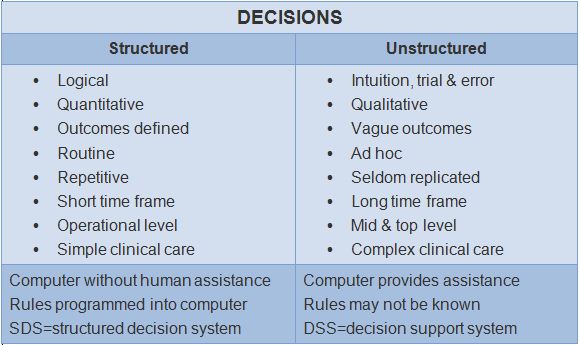
There are three types of decisions: Structured, Semi-structured, and Unstructured. Structured decisions are those made about routine problems with standard solutions, such as the amount to pay a worker for his or her time. Semi-structured decisions are those made about problems that require minimal to moderate amounts intelligence, design, and choice, such as the correct antibiotic to prescribe for an infection. The hardest decisions are usually unstructured. People make decisions of this type about problems for which there is no right or wrong choice. These could be seemingly simple decisions about the appropriate balance of diet and exercise to prevent hypercholesterolemia or complex decisions about whether to seek treatment or go into hospice care. The distinction among types relates to usefulness of the computer to assist in decision making.
Common Decision Theories
Decision processes are the ways in which people make decisions based on a combination of values and anticipated benefits (utility). The two general categories of theories of decision-making are normative (classical) and descriptive. These theories consider the amount of knowledge available, the characteristics of the decision makers, and the possible outcomes of the decisions. Within these general categories are several excellent theories used to describe decision-making.
- Normative Decision Theories are based on how things ought to be. This group of theories includes Rational Actor and Bounded Rationality theories.
- Rational Actortheory says that given a problem to solve and an infinite set of alternatives, a rational person will choose the alternative with the lowest possible risk of consequences and the highest possible level of utility.
- Bounded Rationality theory is similar, but the alternatives fall within a predetermined set. For instance, say you have $15 to buy lunch, you may choose any meal valued at $15 or less.
- Descriptive Decision Theories are based on how things actually are. This group of theories includes the Naturalistic Theory, Game Theory, Bayesian Theory, and Creativity Theory.
- Naturalistic Decision-making Theory describes how an individual will choose between available options, based on his or her experiences. This theory focuses on heuristics, intuition, and individual reasoning techniques. The results of this theory are not always rational. For instance, a firefighter enters a burning building, while others run out.
- Game Theoryfocuses on how decision makers in organizations make decisions. It stresses strategies based upon what decision makers expect their competitors to do. It comes from-and is often used in-military and business applications, such as war games.
- Creativity Theoryis a qualitative theory that attempts to explain how people use invention and creativity to solve problems.
- Bayesian Theoryuses mathematical probability to value the utility of each available alternative using known population parameters, “guesstimates” of unknown population parameters, and sample statistics to create a probability distribution. These probabilities might include subjective as well as objective data in calculations. It allows logical conjecture about otherwise unknown alternatives.
Decision Theory and Technology
Computer technology today allows for decision support systems (DSS) to make normative and some types of descriptive decisions using tools like the Bayesian Model elucidated above. As artificial intelligence and cognitive computing evolves, technology is getting closer to emulating more complex descriptive decisions.
In healthcare, there are rarely decisions that are perfectly right or perfectly wrong. Therefore, the best decisions are those made with the most information available. For example, consider a patient for whom 5 mg. of morphine dulls the pain to a manageable level, but decreases the respiratory rate to 6 breaths per minute. However, 3 mg. does not adequately relieve the pain, but keeps the respiratory rate above 10 breaths per minute. Consider another example in which you must decide whether to recommend discharging a child with leukemia back home with his parents. What factors contribute to such a decision? What information would you need?
Jennings (Jennings, 2006) suggests that the scientific nature of healthcare defines one set of data necessary for this decision, while the art of healthcare defines another set. The focus of this research was on clinical decision support systems (CDSS) related to end-of-life care, but the results can be applied to many aspects of nursing practice. The science of care is amenable to computerization, while the art of care requires human interventions and decisions. This is why CDSS intends to support decisions, not make them.
This website is maintained by the University of Maryland School of Nursing (UMSON) Office of Learning Technologies. The UMSON logo and all other contents of this website are the sole property of UMSON and may not be used for any purpose without prior written consent. Links to other websites do not constitute or imply an endorsement of those sites, their content, or their products and services. Please send comments, corrections, and link improvements to nrsonline@umaryland.edu.