Online Course
NRSG 790-Methods for Research and Evidence-Based Practice
Module 12: Practice Decision Making
Research
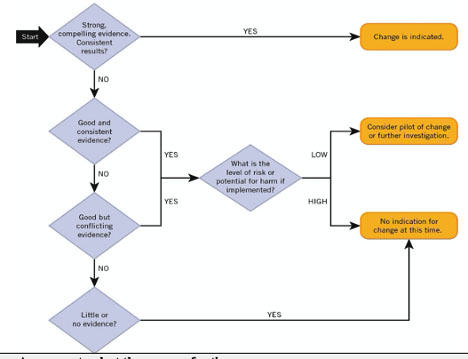
Research has an important role to play in how health care decisions are made. When reviewing evidence to make a practice decision, it is important to understand the different types of evidence that are present in the literature and how to evaluate evidence for strength and quality.
Research Evidence
Knowledge generated from empirical systematic investigation, i.e. research, is highly valued as the basis for making clinical practice decisions. Primary research studies are those that report the original work conducted by the researchers whereas secondary sources are those that compile and evaluate evidence from other sources.
- Examples of primary research are randomized controlled trials, cohort, case control, or descriptive studies.
- Examples of secondary research are systematic reviews and meta-analysis. These are designated as the strongest, highest level, research evidence available to make clinical decisions.
Practice-based Evidence
Practice based evidence, also commonly referred to as internal organizational evidence, is the generation of evidence that is intended to improve practice and patient outcomes within a local setting where it is conducted. Quality improvement or evidence-based practice initiatives are examples of activities that produce practice-based evidence. The findings from these initiatives are not intended to be generalized to other setting, but rather improve quality, outcomes, and performance within the practice setting.
Evidence Synthesis
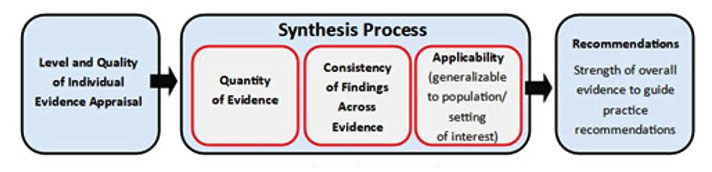
Evidence synthesis has an important role to play in how health care decisions are made. Practice cannot be based on the findings from a single study alone. A single study could be valid, but it could also be biased, with inaccurate conclusions. Therefore, a synthesized body of research is needed to demonstrate consistent findings, from consistent procedures, with a consistent population.
Evidence synthesis refers to the process of bringing together information from a range of sources to inform decisions. Group like-level evidence together and analyze for similarities and differences in methodology and findings. Like-design studies, with more consistency in their sample, power, setting, procedures, validity, reliability, and findings are regarded as having higher quality. Refer to the Evidence Review Table under the Assignment Tab for the Synthesis Table Template and example.
This website is maintained by the University of Maryland School of Nursing (UMSON) Office of Learning Technologies. The UMSON logo and all other contents of this website are the sole property of UMSON and may not be used for any purpose without prior written consent. Links to other websites do not constitute or imply an endorsement of those sites, their content, or their products and services. Please send comments, corrections, and link improvements to nrsonline@umaryland.edu.