Online Course
NDNP 803 - Executive Leadership and Healthcare Economics
Module 3: The Demand for Health Care
Overview
Economists have a very precise definition of demand. For them, demand is the relationship between the quantity of a good or service consumers will purchase and the price charged for that good. More precisely and formally, demand is “the want or desire to possess a good or service with the necessary goods, services, or financial instruments necessary to make a legal transaction for those goods or services."
The Law of Demand: The law of demand states that, ceteribus paribus (latin for 'assuming all else is held constant'), the quantity demanded for a good rises as the price falls. In other words, the quantity demanded and price are inversely related. Demand curves are drawn as 'downard sloping' due to this inverse relationship between price and quantity demanded.
In the context of supply and demand discussions, demand refers to the quantity of a good that is desired by buyers. An important distinction to make is the difference between demand and the quantity demanded. The quantity demanded refers to the specific amount of that product that buyers are willing to buy at a given price. This relationship between price and the quantity of product demanded at that price is defined as the demand relationship.
Supply is defined as the total quantity of a product or service that the marketplace can offer. The quantity supplied is the amount of a product/service that suppliers are willing to supply at a given price. This relationship between price and the ammount of a good/service supplied is known as the supply relationship.
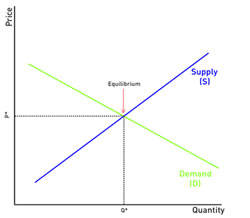
At equilibrium, the quantity supplied and quantity demanded intersect and are equal.
In the diagram below, supply is illustrated by the upward sloping blue line and demand is illustrated by the downward sloping green line. At a price of P* and a quantity of Q*, the quantity demanded and the supply demanded intersect at the Equilibirum Price. At equilibrium price, suppliers are selling all the goods that they have produced and consumers are getting all the goods that they are demanding. This is the optimal economic condition as both buyers and sellers of goods and services are satisfied.
But, what about the demand in health care? In this module, we will take a look at the demand for health care and how that demand is met.
This website is maintained by the University of Maryland School of Nursing (UMSON) Office of Learning Technologies. The UMSON logo and all other contents of this website are the sole property of UMSON and may not be used for any purpose without prior written consent. Links to other websites do not constitute or imply an endorsement of those sites, their content, or their products and services. Please send comments, corrections, and link improvements to nrsonline@umaryland.edu.